
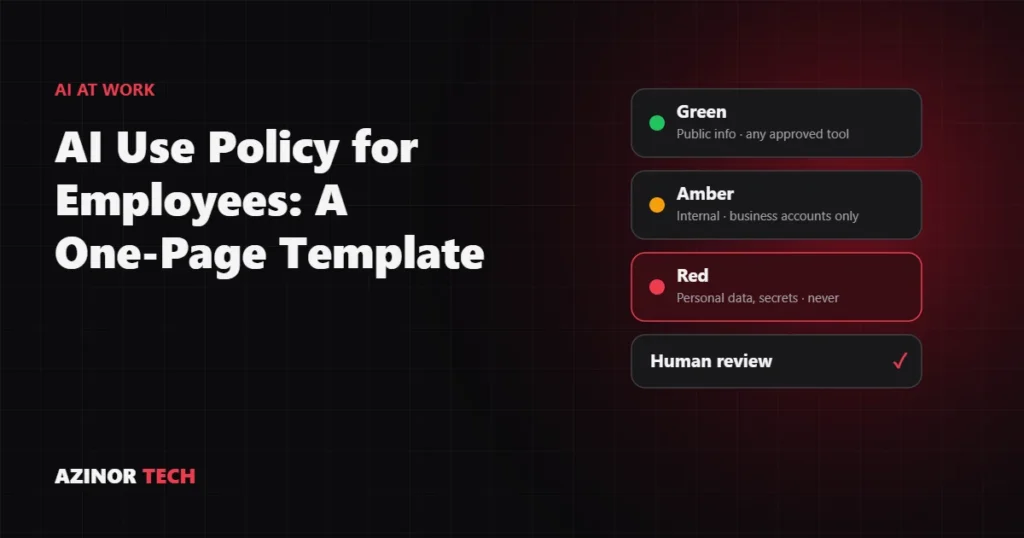
A small business AI use policy should fit on one page and answer four questions for staff: which AI tools they may use, what information must never go into them, when a person must check the output, and who to ask when unsure. Start with a short list of approved tools, a simple green, amber and red rule for data, and a human-review rule for anything that reaches customers. Then train people briefly and keep a record.
This guide explains each part, includes a template you can adapt, and sets out the EU rules that apply. It is general information, not legal advice.
Why a small team needs a written AI policy
Staff often start using AI chat tools, writing assistants and AI browser extensions on their own, usually with good intentions. Without a rule, the same person may paste a public product description one day and a customer complaint with a full name and address the next.
A short policy does three jobs:
- it protects customer and business information from tools you have not checked;
- it stops unchecked AI output from reaching customers, contracts or accounts;
- it is a practical way to inform staff about AI risks, which the AI Act’s AI literacy rule expects organisations to address.
A complete ban rarely works for long. Tools are built into email, office suites and browsers, and people use them anyway. A clear “yes, under these rules” is easier to follow than a “no” that everyone quietly ignores.
What EU rules expect
AI literacy under the AI Act
Article 4 of the EU AI Act asks providers and deployers of AI systems to take measures to support AI literacy among their staff and others using AI on their behalf. According to the European Commission’s AI literacy questions and answers (last updated 20 October 2026):
- the obligation has applied since 2 February 2025, and the rules on supervision and enforcement apply from 2 August 2026, through national market surveillance authorities;
- the Digital Omnibus on AI, which the Commission says entered into force in mid-July 2026, amended Article 4: it remains an obligation, but no specific or “sufficient” level of literacy is mandated;
- no certificate is needed, and organisations can keep an internal record of training and other guidance; a record shows what you did, but it does not by itself prove that your measures were adequate;
- it applies when employees use general tools such as ChatGPT, and they should be informed about specific risks such as hallucination.
In practice, the duty is to take measures, not to hold a document. The Commission’s Q&A says these measures should take into account staff members’ technical knowledge, experience, education and training, and that Article 4 does not require you to test employees’ knowledge. For a small team using general AI tools, that usually means making sure everyone who uses them understands the approved tools, their limits and risks, and the rules in this policy. Deployers of high-risk AI systems also remain responsible for training staff to carry out human oversight.
Personal data under the GDPR
When staff put personal data into an AI tool, the GDPR applies as it does to any other software. Three points matter most for a policy:
- Data minimisation. Article 5 requires personal data to be adequate, relevant and limited to what is necessary for the purpose.
- Processor contracts. If an AI provider processes personal data on your behalf, Article 28 requires a contract or other legal act with that processor. Business plans usually offer a data processing agreement; personal accounts usually do not.
- Breaches. If personal data is exposed, Article 33 requires the controller to notify the supervisory authority without undue delay and, where feasible, within 72 hours, unless the breach is unlikely to result in a risk to people. Breaches must be documented either way.
Step 1: Find out what is already in use
Ask the team, without blame, which AI tools they use and for what. Include:
- chat assistants and writing tools, and whether people use personal or business accounts;
- AI features inside software you already pay for, such as email, office, accounting or shop platforms;
- browser extensions that read or summarise web pages (these often request access to every site, so check them with our Chrome extension safety checklist);
- meeting recorders and transcription apps.
Step 2: Choose approved tools and accounts
Keep the approved list short. For each tool, check its current terms rather than relying on memory, because providers change their plans and settings. The table shows what to look for.
| Question | What a good answer looks like |
|---|---|
| Are our inputs used to train the provider’s models? | No by default, or a setting you control centrally |
| Is there a data processing agreement? | Yes, available to accept or sign |
| Who controls the accounts? | The business can add and remove users |
| How long is data kept, and where? | A stated retention period and processing locations |
| Can access be removed when someone leaves? | Yes, from an admin console |
As an example of the kind of wording to look for, OpenAI’s enterprise privacy page (updated 8 January 2026) says it does not train its models on data from its business plans and API by default. Terms for personal accounts can differ, which is why many policies require business accounts for any work data. This is an illustration, not a recommendation of one provider.
Step 3: Set a traffic-light rule for data
Most mistakes happen when someone pastes the wrong thing. A three-colour rule is easier to remember than a long list.
| Colour | Examples | Rule |
|---|---|---|
| Green | Published product information, public web content, your own draft text without personal data | Any approved tool |
| Amber | Internal documents, supplier terms, customer messages with names and contact details removed | Approved business accounts only |
| Red | Passwords, API keys, payment card or bank data, ID numbers, health information, customer personal data, confidential contracts, source code containing secrets | Never, unless a specific tool has been approved for that exact purpose under a processor contract |
The OWASP project lists sensitive information disclosure among the top risks for AI applications and notes that users need to understand the risk of unintentionally providing sensitive data. The red row exists for that reason.
Step 4: Require human review where it matters
AI tools can produce confident answers that are wrong. A person must check output before it:
- is sent to a customer, supplier or authority;
- is published on your website or social channels;
- informs a decision about money, contracts, staff or eligibility;
- goes into production systems, if you write code.
The business remains responsible for what it tells customers. In a 2024 Canadian case, a tribunal ordered Air Canada to compensate a customer who relied on wrong information from its website chatbot, rejecting the airline’s argument that it was not liable, as reported by Global News. If you plan to put AI in front of customers, read our AI chatbot readiness guide first.
Step 5: Train briefly and keep a record
A 30 to 45 minute session is often enough for a small team. Cover the approved tools, the traffic-light rule, two or three examples of wrong AI answers, and how to report a mistake. Record the date, who attended and what was covered. Repeat it when you add a new tool. The record is useful evidence of what you did; it is not a certificate and does not by itself guarantee compliance.
Step 6: Decide what happens when something goes wrong
People will occasionally paste red data by mistake. Make reporting quick and blame-free, because a hidden mistake is worse than a reported one.
- The person tells the policy owner the same day: what was shared, in which tool and account.
- Delete the conversation or file if the tool allows it, and note whether deletion is confirmed.
- Rotate any exposed password or key immediately.
- If personal data was involved, assess whether it is a personal data breach and whether the 72-hour notification rule applies. Record the decision either way.
One-page AI use policy template
Copy this into a document and replace the parts in square brackets. Keep it to one page.
- Purpose. We use AI tools to save time on routine work while protecting customer data, business information and our reputation.
- Scope. Applies to everyone working for [business name], on any device, when doing company work.
- Approved tools. [Tool, plan, what it may be used for]. Work data goes only into business accounts that the company controls.
- New tools. Ask [policy owner] before using any other AI tool, AI browser extension, meeting recorder or AI feature that is switched off by default.
- Data rules. Green: any approved tool. Amber: approved business accounts only. Red: never, unless approved in writing for that purpose.
- Human review. A person checks AI output before it is sent outside the company, published, or used for decisions about money, contracts or people.
- Honesty. Do not present AI output as checked fact, and follow any labelling rules that apply to the content.
- Mistakes. Report pasted red data or a harmful AI output to [policy owner] the same day. Reporting will not be punished.
- Training. Everyone completes the short AI briefing when they start and whenever a new tool is approved.
- Owner and review. [Name] owns this policy and reviews it every [six] months. Last reviewed: [date].
Worked example: a four-person online shop
Hypothetical example for illustration.
A small online shop with four staff finds that two people use personal chat accounts to draft customer replies, one uses an AI extension to summarise supplier pages, and nobody has checked any of the terms.
- Tools: they approve one business chat plan with a data processing agreement and training switched off by default. Personal accounts are no longer used for work.
- Data: order numbers and product questions are amber; customer names, addresses and payment details are red, so staff remove them before drafting a reply.
- Review: every customer reply is read and edited by the person who sends it.
- Extension: the summariser requested access to every site and its privacy practices were vague, so it was removed.
- Training: one 40-minute session, recorded in a shared document with the date and attendees.
Frequently asked questions
Does a small business legally need an AI policy?
EU law does not require a document with that name. However, the AI Act expects measures to support staff AI literacy, and the GDPR applies to personal data in AI tools. A short written policy is a practical way to support both and to show what you did, although no single document guarantees compliance.
Can employees use free AI chat tools for work?
That is your decision, but personal and free accounts often have different data settings from business plans and no processor contract. Many small businesses allow them only for green data, or not at all for work.
Should we ban AI tools completely?
A ban is simple to write but hard to enforce, because AI features are built into everyday software. A short list of approved tools with clear data rules is usually easier to follow.
Do employees need an AI certificate under the AI Act?
No. The European Commission says no certificate is needed for Article 4. The obligation is to take measures that support AI literacy for the people who use AI on your behalf, taking into account their knowledge, experience and training. Keeping an internal record of training and guidance is optional but useful to show what you did; it does not by itself prove compliance.
Where AZINOR TECH stands
AZINOR TECH does not currently offer AI policy, consultancy or compliance services. This template is a starting point to adapt with your own adviser. For related decisions, see our guides on choosing an AI consultant and AI agents versus automation.
Sources
- European Commission, AI Literacy: Questions and Answers (updated 20 October 2026)
- GDPR Article 5, Article 28 and Article 33
- OWASP GenAI Security Project, LLM02:2025 Sensitive Information Disclosure
- OpenAI, Enterprise privacy at OpenAI (updated 8 January 2026)
- Global News, Air Canada must pay B.C. man hundreds for chatbot error (February 2024)
Sources reviewed 10 November 2026. Updated 10 November 2026 to clarify the AI literacy and record-keeping wording. This article is general information, not legal advice.