
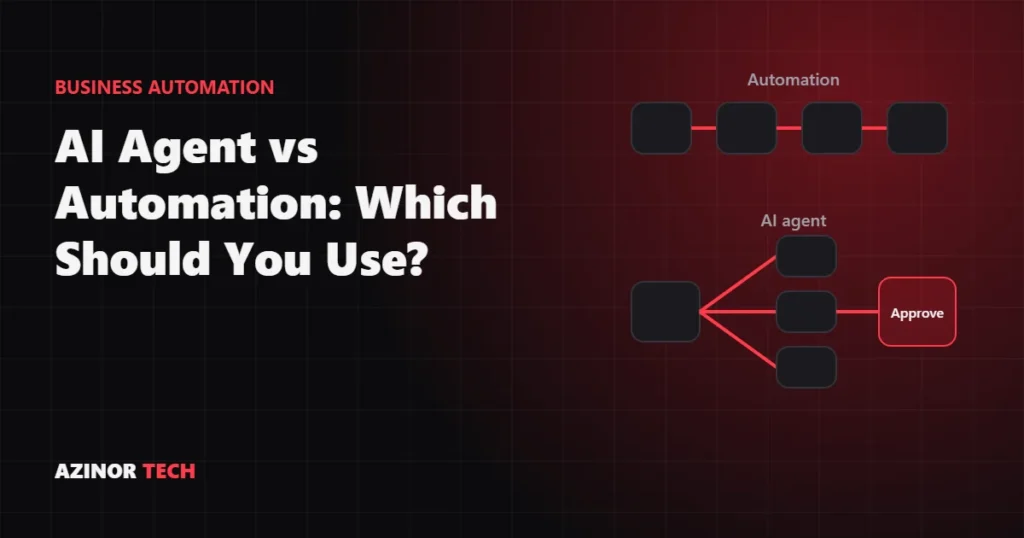
Use regular automation when you can write the steps down in advance. Use an AI agent only when the right steps depend on the situation and the cost of a mistake is controlled. For most small-business processes the best answer is a fixed workflow with one AI step inside it, not a fully autonomous agent.
The search for “agents” often starts with the technology. It works better to start with the process and ask how much of it really needs judgement.
Three different things
- Rule-based automation
- Fixed steps triggered by an event. “When a form is submitted, add a row and send this email.” It does the same thing each time and fails visibly when something unexpected arrives.
- AI-assisted workflow
- The same fixed path, with a language model doing one bounded job such as summarising, classifying or drafting. Your workflow still decides what happens next.
- AI agent
- A model decides which actions to take and in what order, using the tools you give it, and adjusts based on the results.
Anthropic’s engineering guide, Building effective agents, draws the same line: workflows follow predefined code paths, while agents direct their own processes and tool use. It also recommends finding the simplest solution possible and adding complexity only when needed, which may mean not building an agent at all. Anthropic sells AI models, so that advice is notable.
How they compare
| Rule-based | AI-assisted workflow | AI agent | |
|---|---|---|---|
| Handles messy input | Poorly | Well, at the AI step | Well |
| Predictable result | High | Mostly; AI step varies | Lowest |
| Running cost | Usually lowest | Grows with AI use | Usually highest and least predictable |
| Debugging | Easy to trace | Moderate | Harder; needs step logs |
| Main risk | Breaks on exceptions | Wrong output at one step | Wrong actions that compound |
The comparisons above are general tendencies rather than measurements. Anthropic’s guide makes the cost point directly: agentic systems often trade latency and cost for better task performance, and more autonomy brings a risk of compounding errors.
One process, three ways
Take a small online shop handling “where is my order?” emails.
- Rule-based: a customer enters an order number in a form, and the system replies with the tracking status. Cheap and reliable, but only for people who use the form.
- AI-assisted: a model reads the free-text email and extracts the order number and the request. The workflow looks up tracking and drafts a reply. Staff approve anything unusual. This covers most of the messy cases without handing over control.
- Agent: a model reads the email and decides whether to check tracking, contact the courier, issue a refund or reship. It can handle odd cases, but it can also refund someone it should not.
For this shop, the middle option is probably the right one. The agent adds little, because the possible actions are few and already known.
A five-question decision test
- Can you draw the process as a flowchart? If yes, use a workflow.
- Is the difficulty only in reading messy input? Add one AI step to the workflow.
- Do the needed steps truly vary, case by case? Only now is an agent worth considering.
- Can a mistake be undone cheaply? If not, require a person to approve that action.
- Is there enough volume to justify it? Rare tasks may not repay the setup and supervision.
If you do use an agent, limit it
The OWASP GenAI Security Project lists excessive agency as a top risk for language model applications: tools that allow damaging actions in response to unexpected, ambiguous or manipulated output. It names three root causes, and each one points to a practical control.
| Root cause | What it looks like | Control |
|---|---|---|
| Excessive functionality | A mail tool that can also delete messages | Offer only the tools the job needs |
| Excessive permissions | Admin login to the shop system | Read-only or narrowly scoped access |
| Excessive autonomy | Sends refunds without any check | Human approval for high-impact actions |
Keep in mind that emails and web pages can contain text designed to manipulate a model. An agent that reads customer email is reading untrusted input, so its permissions need to be set outside the model and enforced by the systems it connects to. Keep a log of each action, set a maximum number of steps and test on a copy of your data before going live.
Personal data still counts here. If an agent reads customer records or sends them to an outside AI service, you need to know what is stored and where, and have the right contract with the vendor. Decisions with serious effects on people need extra care, and GDPR has specific rules on solely automated decisions, so get advice before automating anything of that kind.
Good first automations
- Sorting incoming email and drafting replies for a person to send.
- Turning supplier invoices into structured rows, with checks on the totals.
- Summarising support tickets each week to find recurring problems.
- Producing first drafts of product descriptions from a fixed fact sheet.
These share a useful property: a person sees the result before it reaches anyone outside the business.
Frequently asked questions
What is the difference between an AI agent and automation?
Automation follows steps you defined in advance. An AI agent chooses its own steps towards a goal, using the tools it has been given. Automation is more predictable; an agent is more flexible and needs more supervision.
What is the difference between an AI agent and a chatbot?
A chatbot mainly answers in conversation. An agent takes actions in other systems, such as updating a record. The line is blurry, since a chatbot connected to tools can act like an agent. For the customer-facing side, see our chatbot readiness guide.
Do small businesses need AI agents?
Usually not as a first step. Many repetitive tasks can be handled by a plain workflow or one AI step inside it. Consider an agent once a real process keeps defeating those simpler options and its actions can be safely limited.
Are AI agents safe to connect to business systems?
That depends on the access they get. Use narrow permissions, separate read from write access, require approval for high-impact actions, keep logs and test on non-production data. These reduce risk; they do not remove it.
Where AZINOR TECH stands
AI agents and business automation are areas AZINOR TECH intends to work in. They are not yet listed as services on this site, and we have no customer results to show you. If you have a process you are trying to untangle, you can describe it to us and we will tell you honestly whether we can help at this stage. If you are also deciding whether to subscribe to a tool or commission your own, read our build vs buy guide.