
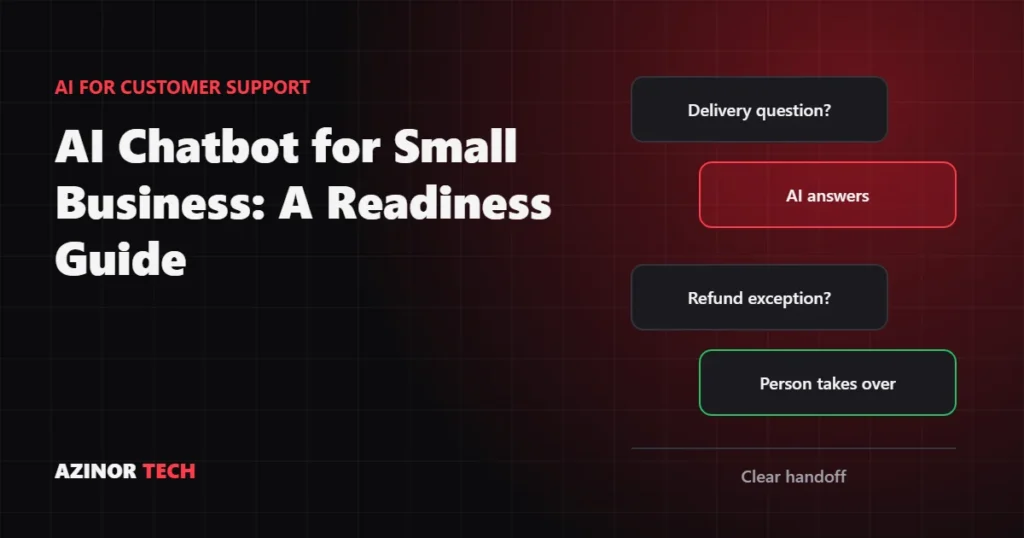
An AI chatbot is worth adding to a small business when customers ask the same questions repeatedly, you have written answers it can rely on, and a person can take over when it should not answer. If any of those three is missing, fix that first. A chatbot placed on top of messy information gives wrong answers faster.
Most guides on this topic jump straight to a list of tools. The more useful first question is whether your support work has the right shape for one.
The four-question readiness test
Look through your last 50 customer messages, or as many as you have, and answer these.
| Question | Good sign | Warning sign |
|---|---|---|
| Are questions repetitive? | Many are about hours, delivery, returns, setup | Most need someone to look into a specific case |
| Are answers written down? | Current policy and help pages exist | The answers live in one person’s head |
| Can you hand off cleanly? | Someone checks the queue and has the chat history | Nobody would see an escalated message |
| Is a wrong answer tolerable? | The mistake is easy to correct | It could cost money or involve health, legal or safety issues |
Two or more warning signs mean a better FAQ and saved replies will probably help you more right now.
What a small-business chatbot does well, and badly
A chatbot trained on your own content is good at finding and rephrasing information, at any hour: “Do you ship to Austria?” or “How do I reset the device?” It is also useful for collecting details before a person picks up: an order number, a product model, a photo of the problem.
It is weak where judgement or authority is involved. Refund exceptions, complaints, angry customers and anything requiring account access need more care. Language models can produce a confident answer that is simply wrong, so it should not be the last word on anything that matters to the customer.
You remain responsible for what it says
The case usually cited here is Moffatt v. Air Canada. The airline’s website chatbot gave a customer wrong information about a bereavement fare. Air Canada argued it could not be held responsible for what the chatbot said, and British Columbia’s Civil Resolution Tribunal ordered it to pay just over $650 in damages.
That is one small-claims decision in Canada, not a rule for every country. The practical lesson travels anyway: customers will treat the chatbot as your business speaking, so limit what it can promise.
Privacy and EU rules to check
This is general information, not legal advice. If you serve customers in the EU, take the following to your adviser.
- Tell people it is AI. Article 50 of the EU AI Act covers systems that talk directly with people. The European Commission’s FAQ places this design duty on providers and says people should be informed from the start of the first interaction, unless it is obvious. Even if you are only using someone else’s chatbot, ask the vendor how it handles this and keep a clear label on.
- Know what data goes where. Customers type names, order numbers and sometimes health or payment details into chat windows. Find out where messages are stored, for how long and whether the vendor uses them to train models.
- Get the processor contract. A vendor handling personal data on your behalf generally needs a data processing agreement under GDPR Article 28. Ask for it before going live, and update your privacy notice.
- Keep the risks in view. A report written by outside experts under the European Data Protection Board’s Support Pool of Experts programme covers privacy risks and mitigations in large language models. It gives its authors’ views, not an official EDPB position, but it is a useful reference for the questions to put to a vendor.
A low-risk way to start
- Clean up the source material. Update delivery, returns and setup pages. Delete old versions. The bot can only be as accurate as what you give it.
- Pick one narrow job. For example, only delivery and returns questions. Everything else goes to a person.
- Write test questions before buying. Include 20 real questions, plus awkward ones: a refund outside policy, a request for a discount, a question you never covered. Run them on every tool you try.
- Set hard limits. It should not invent prices, promise refunds or give medical or legal advice. When unsure, it should say so and offer a person.
- Make the handoff obvious. A visible way to reach a human, with the conversation passed along, so nobody has to repeat themselves.
- Read transcripts every week. Fix wrong answers at the source. Widen the scope only when the narrow job is working.
What to compare between tools
- Sources. Can it be limited to your content, and does it show where each answer came from?
- Handoff. Does it work with your email or help desk?
- Data terms. Retention, training use, hosting location and a data processing agreement.
- Pricing basis. Per seat, per message or per resolved conversation. Work out a month at your own volume, because a low entry price can look very different at scale.
- Exit. Can you export conversations and your knowledge base if you leave?
If the job grows from answering questions into carrying out tasks such as issuing refunds, you are moving into different territory. Our guide to AI agents and automation covers that decision.
Frequently asked questions
Does a small business need an AI chatbot?
Not automatically. It makes sense when repetitive questions take real time and reliable written answers exist. If you get a handful of varied messages a day, personal replies and a good FAQ may serve customers better.
Can a chatbot replace customer support staff?
It can take on routine questions, but someone still needs to handle exceptions, complaints and mistakes, and to keep its information up to date. Plan for human review rather than for no humans at all.
Do I have to tell customers they are talking to a bot?
In the EU, AI Act Article 50 requires that people be informed unless it is obvious, with the duty placed on providers. Labelling it clearly is simple and sensible in any case. Check your own position with an adviser.
How do I measure whether it works?
Track how many conversations end without needing a person, how many answers were wrong in a weekly transcript sample, and whether repeat contacts go down. Deflection alone can hide frustrated customers who simply gave up.
Where AZINOR TECH stands
AZINOR TECH’s current products are privacy tools. AI chatbots and business automation are a direction we are working towards, not a service you can buy on this site yet. If you are weighing up a chatbot and want to tell us about your situation, get in touch; hearing about real support problems helps us shape what we build.