
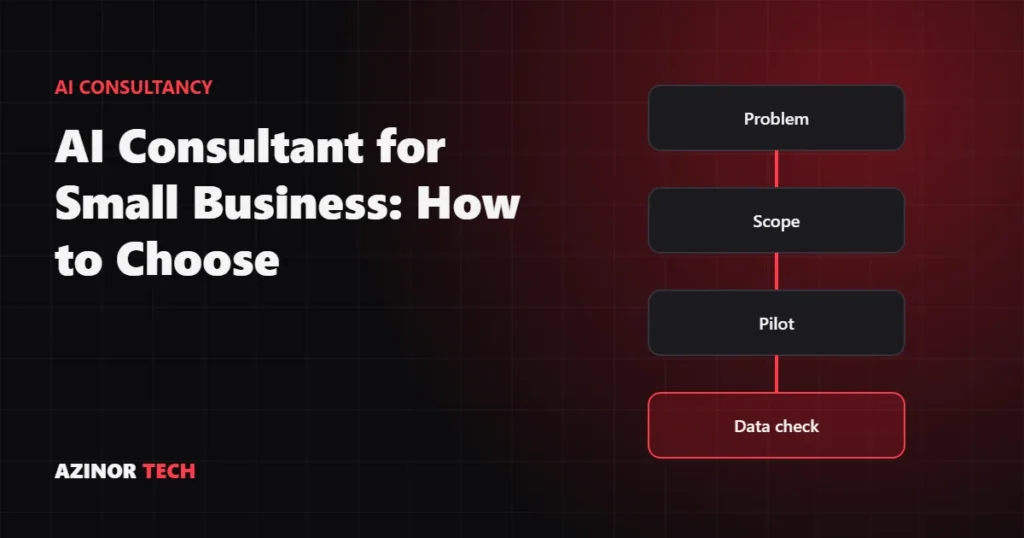
A small business should hire an AI consultant only after it can name one specific problem, such as slow replies to quote requests or hours spent retyping invoices. Then choose the consultant who proposes a small, measurable pilot, explains in writing where your data will go, and is willing to tell you when AI is not the right fix.
The rest of this guide covers how to find that first problem, what to ask before you sign, and how to keep customer data safe while you test.
Start with a problem, not with “AI”
A request like “we want to use AI” gives a consultant nothing to measure. A request like “we answer the same 30 delivery questions every week and it takes most of a morning” does. The second version tells everyone what success looks like before any tool is chosen.
Good first projects usually share five traits:
- Frequent. The task happens daily or weekly, so a small improvement adds up.
- Text- or document-heavy. Emails, forms, invoices and notes are where current AI tools are strongest.
- Measurable. You can count time spent, errors or response times before and after.
- Low harm if wrong. A person can check the output before it reaches a customer.
- Backed by data you are allowed to use. The information exists, and you have the right to process it this way.
| Usually a good first project | Usually a poor first project |
|---|---|
| Drafting replies to common emails for staff to approve | Fully automatic replies to complaints |
| Extracting fields from supplier invoices, with total checks | Automatic payments without review |
| Summarising meeting notes or support tickets each week | Decisions about staff, credit or eligibility |
| Searching your own manuals and policies | Medical, legal or safety advice to customers |
Write a one-page brief before you call anyone
A short brief saves paid hours and makes quotes comparable. Include:
- The task, who does it today, and how often.
- Rough time or cost today, even if it is only an estimate.
- What a good result would look like in numbers.
- The systems involved, such as your email, shop or accounting software.
- What data is involved, and whether it includes personal or sensitive information.
- What must never happen, for example sending anything to a customer without a check.
What a consultant should actually deliver
Consultancy work tends to move through four stages. Ask each candidate which stages they cover, and what you receive at the end of each one.
| Stage | What you should receive | Watch out for |
|---|---|---|
| Discovery | A written problem statement, options including “do nothing”, and rough costs | A tool chosen before your process was understood |
| Pilot | A small working version tested on real or realistic examples, with measured results | Demos that only use the consultant’s own examples |
| Implementation | The working setup in your accounts, with documentation | Everything running in the consultant’s private accounts |
| Handover | Instructions, access transfer and a plan for who maintains it | No way to keep running it if the consultant leaves |
Questions to ask before you hire
- What problem do you think we should solve first, and what would you not use AI for here?
- Which AI provider or model would you use, and why that one?
- Where will our data be stored and processed, and by which companies?
- Will any of our data be used to train someone else’s model?
- How will we measure whether the pilot worked?
- Who owns the prompts, workflows and code you build?
- What happens when the AI gives a wrong answer? Where does a person check it?
- What does it cost to keep running each month after you hand it over?
Red flags
- A guaranteed saving or return before anyone has looked at your process.
- Vague answers about where data goes, or no written contract for data handling.
- Pressure to automate customer-facing decisions with no human review.
- Everything built in accounts you do not control, with no handover plan.
How to protect customer data
This is general information, not legal advice. Take the specifics to your adviser.
If a consultant or AI tool processes personal data on your behalf, the GDPR generally requires a written contract with that processor. Article 28 states that processing by a processor “shall be governed by a contract or other legal act”. In practice, that means you should know:
- which companies process the data, including the AI provider behind the consultant’s tools;
- where the data is processed and how long it is kept;
- whether it is used for model training;
- who has access, and how access is removed when the work ends;
- how data is returned or deleted at the end of the contract.
Two practical habits reduce risk further. Test pilots with anonymised or made-up examples where you can. And keep a person reviewing outputs before they reach customers, at least until you have evidence the system behaves reliably.
If you connect AI to systems that can take actions, such as sending emails or changing records, limit what it can do. The OWASP GenAI Security Project describes excessive agency as giving a model more functions, permissions or autonomy than the job needs, and recommends human approval for high-impact actions.
Your own team matters too. Under the EU AI Act as amended by the 2026 Digital Omnibus, Article 4 asks providers and deployers of AI systems to take measures to support AI literacy among the people who operate those systems for them. A good consultant should leave your staff knowing what the tool does, where it fails and when to escalate. Our AI use policy template shows one simple way to set those ground rules.
For a structured way to think about risk, the US NIST AI Risk Management Framework is a free, voluntary reference. It organises the work into four functions: Govern, Map, Measure and Manage. You do not need to adopt it formally, but its questions are useful when reviewing a proposal.
Common ways consultants charge
| Model | Suits | Trade-off |
|---|---|---|
| Fixed-price discovery | Finding out whether a project is worth doing | Small cost; may conclude “do not build” |
| Fixed-price pilot | Testing one clearly defined task | Needs a precise scope to avoid disputes |
| Hourly or daily rate | Unclear or changing work | Total cost is harder to predict |
| Monthly retainer | Ongoing maintenance and improvement | Can continue after value has levelled off |
We have not listed typical prices, because they vary widely by country, scope and experience. Compare written quotes for the same brief.
Measure the pilot honestly
Record the baseline before the pilot starts: how long the task takes, how many errors occur, and how quickly customers get replies. Then measure the same things during the pilot, including the time staff spend checking AI output. A tool that saves an hour but needs 50 minutes of review is not yet a win.
If the project grows from drafting answers into taking actions, read our guides to AI chatbots for small businesses and AI agents versus automation. If you are deciding between a subscription tool and a custom build, see build vs buy software.
Frequently asked questions
What does an AI consultant do for a small business?
An AI consultant helps identify tasks where AI could help, tests a small version on real examples, sets up the chosen tools and trains staff. A good one also tells you when a simpler fix, such as a template or a better FAQ, would work better.
How do I know if my business is ready for an AI project?
You are ready when you can name one frequent task, measure how it performs today, and access the data needed without breaking your privacy commitments. If any of those is missing, fix it first.
Should an AI consultant have access to customer data?
Only what the work needs, under a written contract that covers storage, retention, training use and deletion. Use anonymised or test data for pilots where you can, and remove access when the work ends.
Can AI consulting guarantee cost savings?
No one can honestly guarantee savings before studying your process. Treat a promised return as a red flag, and judge results from a measured pilot instead.
Where AZINOR TECH stands
AZINOR TECH’s current products are privacy software. AI consultancy, chatbots and automation are areas we are building towards, but they are not yet offered as services on this website. If you are planning an AI project and want to describe it, contact us; real business problems help shape what we offer.